Manuscripts
Night Book
Image not available
You might also be interested in
Image not available
Commonplace book
Manuscripts
Commonplace book containing two quotations from Shakespeare's Othello, along with passages and translations from classical texts, notes on classical and mythological figures, remedies, household hints and practical notes, theological notes and arguments, poems, epigrams and sententiae, legal forms, rentals for land around Kirby Knowle [North Yorkshire], and copies of letters and documents
mssHM 60413
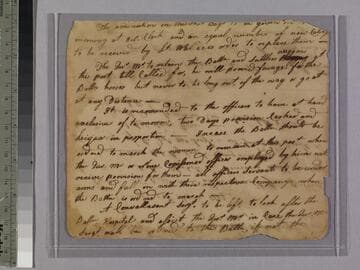
Orderly book of the 71st Highland Regiment of Foot (Fraser's Highlanders), 1779, Apr. 27 - June 15
Manuscripts
A battalion orderly book covers Prevost's raid. The first entry, April 27, 1779, was penned when the British forces concentrated at Ebenezer, Ga., about to cross into South Carolina; the last is dated June 15, five days before the British victory of Stono Ferry. The orders cover different aspects of the campaign: logistics; Southern loyalists; numerous Negro slaves who "horly resorts to the army," and particularly "great want of Dissiplen." The orders for May 29 noted that "the Batt[alio]n is now become so notorious for maurauding & plundering White & Negroe women of all Denominations, the men absenting themselves from camp day & night without leave asked or given," that the commanding officer had to call on other officers to "to exert their authority in support of their own character & at least to preserve some part of that character given to Scotsmen on the field."
mssHM 72267
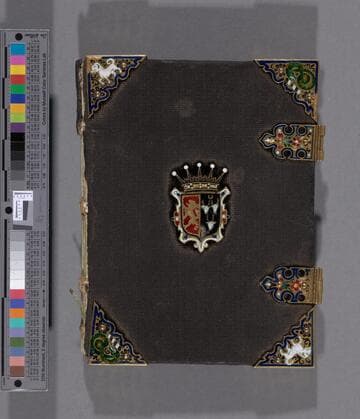
Crypto-Catholic Shrewsbury prayer book : manuscript
Manuscripts
1. f. 1r-v. Morning prayer. Lighten myne eyes o Lorde, least at any tyme I oversleepe in sinne, and least myne enemy doe say I have prevailed against him ... 2. ff. 1v-2r. Evening prayer. Allmighty and everlasting God, I render thee most heart thanckes, for that thou has vouchsafed of thy great mercy and goodnes, to preserve mee this day from all evill ... 3. ff. 2r-3v. A prayer to stirre up the minde to devotion in prayer. Allmighty and most mercifull Father, unto thee all the heavenly company of the Celestiall cytie, all the blessed orders of saved spirits do wth due reverence sing continuall glorie and everlasting praise ... 4. ff. 3v-10r. A confession of my sinnes & weaknesses wth petitions for the pardoning of the one, & strengthening of ye other. Have mercie vpon mee and spare mee good Lorde, and suffer mee not to perish in my sinne ... 5. ff. 10r-18r. Another confession wth such like petitions. Graunt me most mercifull God, fervently to desire such thinges, as may bee acceptable and pleasing unto thee, wth wisedome to serch after those, not to bee deceived in the knowledge of those, and unfainedly to accomplish the doing of those ... 6. f. 18r. A prayer desiering God to order & direct mee. Lorde God thou knowest what thing is to mee most profitable to doe, this or that, after thy will: ... 7. ff. 18v-19r. A thankesgiving for my beeing. O God thou mightest have kept mee from being at all, and (being) thou maist make mee, as if I never had been, but seeing of they wonderfull goodnes, also doost suffer mee still to bee: ... 8. ff. 19r-20r. Before the receiving of the holy Sacrament. O Benigne Jesu that wouldest suffer so many grevous paynes, yea death itself for love of mankinde, great and marveilous is they charity, give mee grace to receive, thy precious body in forme of bread this day, with purity of heart and cleanes of soule, with love, dread, and stedfast beleef. ... 9. ff. 20v-21r. After receiving the holy Sacrament. Thankes bee unto thee o holy Father God Almyghty, that thou didst vouchsaufe of thy great pity, to send thy only sonne from thy high throne into this vale of woe & miserye, ... 10. ff. 21r-22v. A prayer or thanckesgiving unto ye Holy Trinity. O Blessed Lorde God, Father, Sonne and Holy Ghost, three personnes and one God, my Lorde, my God, my maker, my redeemer, my norisher, my defender, my sweetnes, my mercy, my refuge, my strength, my victory, my joy, and my glory eternall; I laud thee, I glorifie thee, I honor thee. ... 11. ff. 22v-24v. Prayers in Sicknesse. O Sweete Jesu, I desire nor life, nor death, but they most holy will. Thee O Lorde I looke for, bee it unto mee according to thy pleasure. If thou wilt sweete Jesus that I dye, receive my soule ... 12. ff. 24v-25r. A prayer for a sick body ready to die. Have mercy and spare him o Lorde; deliver him from thine anger, from an evill death, from the danger of death; from the paines of hell, from all evill, from the power of the Devill. ... 13. ff. 25r-26r. Christ deliver thee from all torment, who was crucified for thee. Christ deliver thee from death, who hath vouchsafed to dye for thee; Christ the sonne of the living god, place thee in the garden of his paradise, which alwaies is pleasant and flourishing ...
mssHM 83695
Image not available
William L. Jackson journal
Manuscripts
Journal kept by William L. Jackson during his voyage up the Missouri River on board the Steamer Gallatin from April to June 1866. Jackson, who was traveling with his friend and fellow Civil War veteran John P. Eddy, kept nearly daily journal entries from the time he boarded the Gallatin at Fort Leavenworth on April 22 until June 14, three days before the accident that would cause his death. These entries describe life on board the steamer and its progress as well as Jackson's observations on various stops along the way, including St. Joseph, Nebraska City, Sioux City, Omaha, Fort Thompson, Fort Sully, Fort Rice, and Fort Berthold. Jackson, who was able to utilize his medical training when a passenger accidentally shot himself in the leg with his shot gun, was particularly observant of the conditions of local drug stores ("I never saw three dirtier drug stores," he remarked of Omaha). He also noted that Nebraska City was "full of men waiting to cross the plains, many of them...dead broke;" that Omaha was the starting point of the "great" Union Pacific Railroad and that he saw Teamsters, "Yahooes and Muleskiners," "swarthy" Mexicans, Indians "dressed in buckskin and blankets," boatmen, farmers, soldiers, and clerks in the streets together; and that Sioux City was "quite dull" but the people there had "high hopes" for a "big city" when the railroad came through. Jackson also records notes on Indians he saw or encountered, including "300 Indians...engaged in the massacre in Minnesota" who had been pardoned and were to be "turned adrift up the river;" members of the Winnebago tribe near the Little Sioux River, who were "very fair looking;" a "large encampment of Sioux" at Fort Thompson waiting to be moved to Yankton; and "3000 Siouxs" near Fort Rice who were "waiting to make a treaty with the government." Although not much interested in hunting, he reports that members of the crew shot at buffalo, antelope, and a gray wolf, as well as killing rattlesnakes. Despite his occasional bouts of homesickness, Jackson seems to have enjoyed the trip, which was however not without its technical difficulties, as the crew dealt with damaged pumps, a broken rudder, and a leaking boiler "apt to blow," and were "frightened out of our wits" by a ruptured steam pipe. A note at the end of the journal copied from the family Bible records Jackson's death after an accident caused by a burst flue on June 17 (he died from his injuries on June 19).
mssHM 75878
Image not available
Speed Family Papers
Manuscripts
The collection consists of 305 letters, indentures, announcements, and receipts. There are also 19 pieces of ephemera and 39 albumen, tintype, and daguerreotype photographs. The majority of the correspondence in the collection (179 letters) was sent to John James Speed (1803-1867) from business associates and family members. George James Pumpelly wrote more letters than any other associate, sending 99 letters to Speed between 1853-1863. He talks about business finances, owing and collecting money, and various business ventures that Speed is involved in at the time. Some of his letters discuss investigating the purchase of coal mines and Speed's attempt to build a telegraph line from St. Louis, Missouri, to the West coast. Several of the letters sent by various people during 1832 congratulate Speed on his appointment to the New York State legislature. Ann Speed (d. 1881) writes 5 letters to her husband during the period while he is in the legislature and living in Albany, New York. Her family also corresponds with her husband, and her father, Charles Horton Morrell, wrote 13 of these letters. Morrell and his son, Lewis H. Morrell (Ann's brother who sends 2 letters) refer to Speed as "Son" and "Brother," respectively. Speed receives 5 letters from his cousin, Joshua J. Speed; he also receives a few letters from his children. Most of these letters discuss family matters, travel plans, and the weather. Perhaps the most noteworthy item in the collection is an unsigned speech made by John James Speed (1803-1867) at the National Republican Convention in June 1864 in Baltimore, Maryland. He touches on several subjects including President Abraham Lincoln, Vice-Presidential nominee Andrew Johnson, and the Civil War. He also mentions the death of his son, William Johnson Speed (1832-1863) at Gettysburg. The collection also includes 29 indentures written during the early 1800s between John James Speed (d. 1860) and others. Three folders containing ephemera include invitations to a Fourth of July celebration (June 1822) and a New Year's Day (Dec. 1822) party. The collection also contains 39 photographs (Boxes 6-7). A few of the Speed family members have been identified including John James Speed (1803-1867), Cornelia Speed (1847-1884) and Frederic Speed (b. 1841). There is also a photograph of Ezra Cornell (1807-1874) and one of Mrs. Cornell in Box 7. Note: The maiden name of Ann Speed, the wife of John James Speed (1803-1867), was Anne Sophia Morrell, and she signed each of her letters using her married name. She appears in this collection as: Ann Speed, d. 1881.
mssHM 61156-61460
![Prick of conscience ; Piers Plowman ; and other works : [manuscript]](/_next/image?url=https%3A%2F%2Frail.huntington.org%2FIIIF3%2FImage%2F22APN4KG92MZ%2Ffull%2F%5E360%2C%2F0%2Fdefault.jpg&w=750&q=75)
Prick of conscience ; Piers Plowman ; and other works : [manuscript]
Manuscripts
Part 1. ff. 1-16v, 25-32v, 17-24v, 33-94; f. 94v, blank. Pricke of Conscience. Incipit: The ferste part of þis book is soþnesse/ ys ymad of manny wrecchidnesse ffor whan god al þyng had mad of nought/ than of þe foulest matere man was wrought. Explicit: To þe which he vs brynge/ that for our loue maked all þynge. Amen. Here endet þ prikke of conscience. Rubric: Here bigynneþ þe ferste part of þis book þat telleþ of mannys wrecchidnesse. English. Text preceded by a prologue ("Here bugynneþ þe prologe on the Prikke of consciencie þat ferst telleþ of goddes power, The myght of the fadur of heuene/ the wyt of the sone wyth hys ȝyftes seuene"). IMEV 3429; Southern Recension; R. Morris, ed., The Pricke of Conscience. The Philological Society (Berlin 1863), from London, Brit. Lib., Cotton Galba E. ix; see also Stacy Waters,"The Pricke of Conscience: The Southern Recension, Book V," unpublished Ph.D. thesis, University of Edinburgh, 1976; Allen, Writings, 373, n. and 539-40; R. E. Lewis and A. McIntosh, A Descriptive Guide to the Manuscripts of the 'Prick of Conscience.' Medium Aevum monographs n.s. 12 (Oxford 1982) 146-47. Two quires bound out of order. Part 1. ff. 96r-v, 95; f. 95v blank. [William Langland] Piers Plowman. Incipit: //than drede went wyȝtly and warnede fals/ and badde hym fle for fere and his felawes alle. Explicit: Or togreden after goddes men. Whan ȝe delen doles/ In aduenture ȝe hauen ȝoure hire here. And ȝoure heuene als/ Nesciat sinistra manus quid faciat dextra. English. Fragment of Piers Plowman, B-text, ii, 208-iii, 72. IMEV 1459. Leaves rejected by scribe and order reversed; see R. B. Haselden,"The Fragment of Piers Plowman in Ashburnham No. CXXX," Modern Philology 29 (1932) 391-94, and pl. of ff. 96, 121. Part 1. ff. 97-112v. Incipit: Istam sequenciam cantat ecclesia dominica prima adventus domini quia in ea memoria agitur de adventu. Salus fidei generis est integritas corporis. Et dicitur de hoc sal. Explicit: Sed certe debet vocari ita et non eta, ut ipsi greci testantur. Et scribitur hoc nomen IHC cum tribus literis propter misterium ternarii numeri. Rubric: Dominica prima adventus domini sequencia, Salus eterna. Latin. An exposition of sequences which presents some similarities to the printed text, Expositio sequentiarum secundum usum Sarum [Cologne: H. Quentell, 1495]; Copinger 2386. Part 1. ff. 113-205. [William Langland] Piers Plowman. Incipit: In a someres seysoun whan set was the sunne/ y schoop me into shrowdes as y a sheep were. Explicit: and sende me hap and hele tyl y haue peris þe ploghman/ and siþ he gradde after grace tyl y gan awake. Explicit visio petri ploughman. English. Corrections in the hand of the scribe over erasures; text on ff. 156-161v disordered. IMEV 1459; W. W. Skeat, ed., The Vision of William Concerning Piers the Plowman, by William Langland. EETS os 38 (London 1869) particularly xxi-xxiii for description of HM 128; G. Kane and E. T. Donaldson, eds., Piers Plowman: The B Version (London 1975), from Cambridge, Trinity College B.15.17, with variants also from this manuscript; see pp. 9-10 for description of HM 128. See also R. W. Chambers,"The Manuscripts of Piers Plowman in the Huntington Library and their Value for Fixing the Text of the Poem," Huntington Library Bulletin 8 (1935) 1-25. Part 1. ff. 205-216. [Siege of Jerusalem]. Incipit: Here begynneth þe seege of ierusaleem & how it was destroyed, In tyberyes tyme the trewe emperowr/ Sere cesar hym seluen seysyd in rome. Explicit: Wente synggyng awey & lefte woo there/ And hool reedyn to rome yblessyd be god almyȝty. Amen. English. IMEV 1583; E. Kölbing and M. Day, eds., The Siege of Jerusalem. EETS os 188 (London 1932), from Oxford, Bod. Lib., Laud misc. 656, with variants also from this manuscript; see pp. viii-ix for description of HM 128. G. Guddat-Figge, Catalogue of Manuscripts containing Middle English Romances (Munich 1976) 303-04. Part 1. ff. 216v-219. How the Good Wife Taught her Daughter. Incipit: The goode wif taught hir doughter fele tyme & ofte gode woman for to be, Doughter ȝif þou wilt ben a wif & wiseliche werch/ Loke þat þou loue well god & holy cherch. Explicit: Her blessyng mote þou haue & wele mote þou thryue. Wele is þe childe þat thryue may my der childe. Explicit expliciat ludere scriptor eat. English. IMEV 671; T. F. Mustanoja, ed., The Good Wife Taught her Daughter; The Good Wyfe wold a Pylgremage; The Thewis of Gud Women (Helsinki 1948), with Cambridge, Emmanuel College, MS I.4.31 as the basis; HM 126 also edited in full. Also printed from this manuscript by F. Madden, ed., How the Goode Wif thaught hir Doughter (London 1838); by W. C. Hazlitt, Remains of the Early Popular Poetry of England (London 1864) 1:180-92; by C. Hindley, The Old Book Collector's Miscellany (London 1872; reprint of Madden) 2:1. Part 2. ff. 1-2v. [John of Salisbury]. [Letters]. Incipit: //penitencia et satisfactione substiterit in finibus istis. Explicit: Cum ergo hiis angustiis//. Latin. The incipit and explicit of the pastedown in the back of the book are: //pius ihesus quam ipsum pro pace vel gratia hominis. . .responderes id quod etsi imperitis rerum videatur//. John of Salisbury, Letters, ed. W. J. Millor and C. N. L. Brooke (Oxford 1979) v. 2, p. 104 line 18 to p. 110 line 4 and p. 200 line 9 to p. 206 line 4. Layout: 2 columns of 42+ lines, each column 81 mm. wide, ruled in lead. This part formed of the two pastedowns. Assigned Date: s. XIVex.
mssHM 128